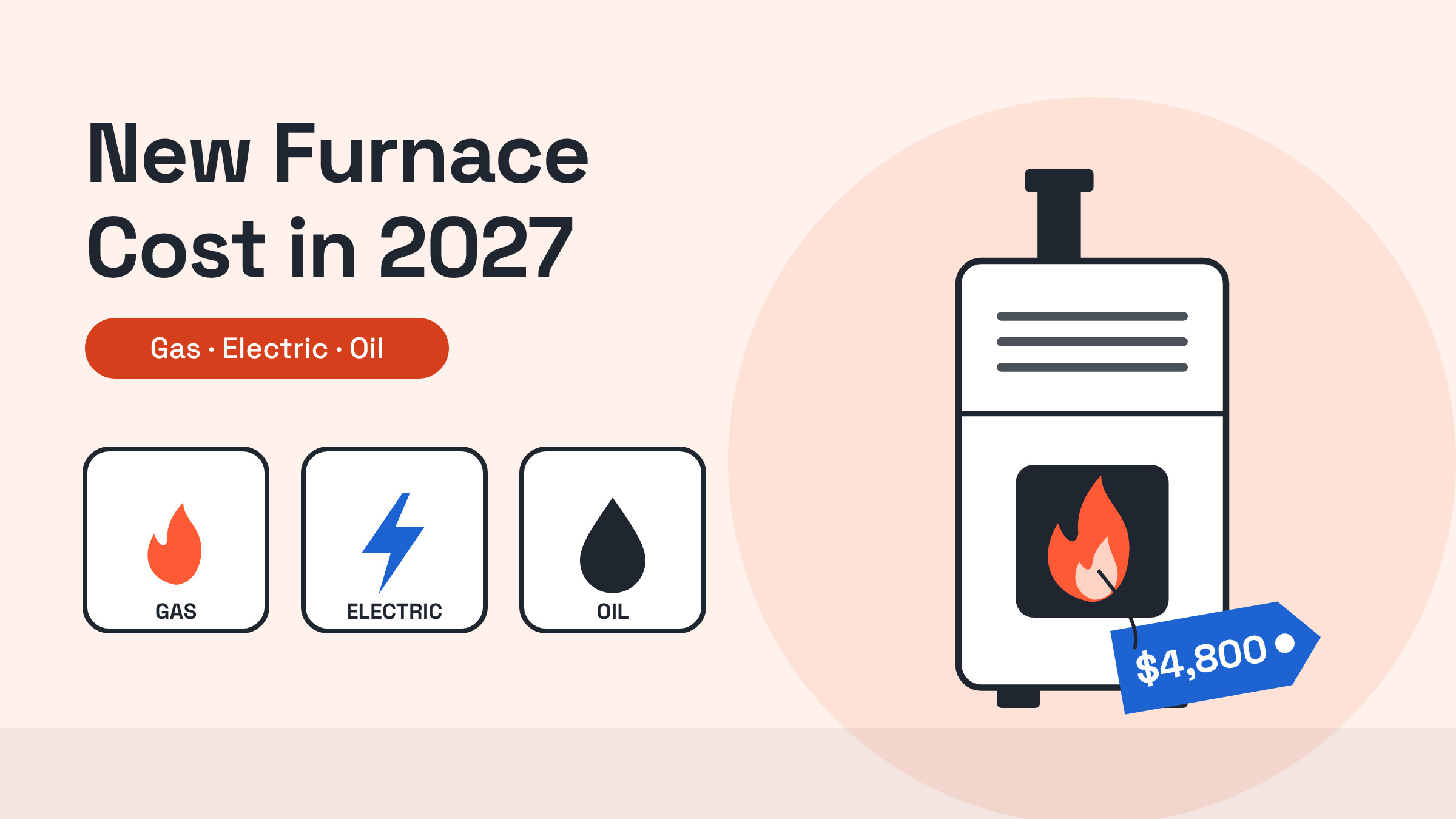
Quick answer: the average new furnace cost in 2027 is about $4,800 installed, and most homeowners pay between $2,800 and $6,900. A basic electric furnace can cost as little as $2,000. In contrast, a high-efficiency gas, propane or oil furnace with new venting often runs $8,000 to $12,000. Your fuel, the furnace size and the work around it decide where you land.
Quick Numbers
Typical installed prices for a 2,000 sq ft home with working ductwork, including labor and removal of the old unit.
| Furnace type | Typical price | Common range |
|---|---|---|
| Gas, standard (80% AFUE) | $4,500 | $3,800–$6,500 |
| Gas, high-efficiency (95%+) | $6,000 | $4,800–$10,000 |
| Propane (95%) | $6,000 | $3,700–$9,000 |
| Heating oil (85–87%) | $8,000 | $6,750–$10,000 |
| Electric | $3,500 | $2,000–$7,000 |
Ranges: 2026 national installed-price data from consumer cost guides and contractor price lists, rounded. Prices are not quotes. Last checked: November 2, 2026.
Calculator
Furnace cost estimator
Estimated installed price
–
typical range for this job
Typical price
–
middle of the range
Furnace size
–
input rating, rounded
Show the math
Heat needed = home size × BTU per sq ft for your climate. Furnace input rating = heat needed ÷ efficiency, rounded up to the next 20,000 BTU size (electric furnaces in kW: BTU ÷ 3,412). Price = base installed range for that fuel and efficiency at 80,000 BTU, adjusted about 4% per 20,000 BTU step, plus $1,000–$3,000 when venting or ducts must change.
New furnace cost by fuel type
Fuel is the first thing that moves the price. It decides the equipment, the venting and the safety work the installer must do. So start here, then adjust for size and efficiency.
Natural gas furnace: $3,800 to $10,000
Gas is the most common choice. Indeed, more than half of U.S. homes with a furnace burn natural gas. A standard 80% AFUE model is the cheapest gas option at about $3,800 to $6,500 installed. However, a 95% condensing furnace costs more because it needs plastic vent pipes and a drain for condensate. That work alone can add $500 to $1,500.
Electric furnace: $2,000 to $7,000
An electric furnace is the cheapest to buy. Because it has no flame, no flue and no gas line, installation is simple. But it is the most expensive furnace to run. Every unit of heat costs you a full kilowatt-hour, and that adds up fast in a cold winter. For that reason, an electric furnace mostly makes sense in mild climates or as a backup.
Propane furnace: $3,700 to $9,000
A propane furnace is almost the same machine as a gas furnace with a conversion kit. Therefore, the unit price is similar. Costs climb when you also need a new tank, a longer supply line or a regulator. With a new buried tank, the total can pass $14,000.
Oil furnace: $6,750 to $10,000
Oil furnaces are the most expensive to install. First, they need a chimney or a power vent, an oil line and often a new tank. Also, fewer contractors install them, so labor costs more. Most oil homes are in the Northeast, where heating oil prices are rising this winter.
What else goes into a new furnace cost
In fact, the furnace itself is often less than half of the invoice. After that come labor, parts and fees. Here is what a typical quote includes, and what can be added on top.
| Item | Typical cost | When you need it |
|---|---|---|
| Furnace (equipment only) | $1,400–$3,000+ | Always; higher for two-stage or modulating models |
| Labor and basic materials | $800–$2,200 | Always |
| Old furnace removal | $200–$350 | Usually included in the quote |
| Permit and inspection | $100–$500 | Required in most cities |
| New PVC venting and drain | $500–$1,500 | Switching from 80% to a 95% furnace |
| Duct repairs or changes | $1,000–$3,000 | Leaky, undersized or damaged ducts |
| New thermostat | $100–$400 | Optional; needed for two-stage control |
| Gas line or propane work | $300–$2,500 | Longer runs, new meter or tank |
Because of these extras, two quotes for the same furnace can differ by thousands. So always compare the scope line by line, not just the total.
How size changes the new furnace cost
Furnaces are sized in BTU per hour. Most homes need between 40,000 and 120,000 BTU. As a rule, each step up of 20,000 BTU adds a few hundred dollars to the new furnace cost. However, buying too big is a real mistake. An oversized furnace short-cycles, wears out sooner and leaves cold spots.
| Home size | Mild climate | Mixed climate | Cold climate |
|---|---|---|---|
| 1,200 sq ft | 40,000 BTU | 60,000 BTU | 60,000 BTU |
| 2,000 sq ft | 60,000 BTU | 80,000 BTU | 100,000 BTU |
| 3,000 sq ft | 80,000 BTU | 120,000 BTU | 140,000 BTU |
Keep in mind that these are rough starting points. A proper Manual J load calculation is the right way to size a furnace. Ask every contractor for one, especially if they suggest a bigger unit than you have now.
Single-stage, two-stage or modulating
Beyond fuel and size, the burner type changes both comfort and price. A single-stage furnace runs at full blast every time it turns on. A two-stage model runs at about 65% most of the time and only goes to full power on the coldest days. Meanwhile, a modulating furnace adjusts in small steps, so the temperature barely moves.
| Burner type | Equipment price | Best for |
|---|---|---|
| Single-stage, 80–92% | about $1,400–$1,800 | Mild climates, tight budgets |
| Two-stage, 95–96% | about $2,000–$2,700 | Most homes in mixed and cold climates |
| Modulating, 97–98% | about $2,500–$3,000+ | Large or drafty homes, comfort-first buyers |
In practice, two-stage furnaces are the sweet spot. They cost only a few hundred dollars more than single-stage units, yet they run quieter and keep rooms more even. By contrast, a modulating furnace saves little extra gas. So pay for one only if comfort is your main goal.
Brand tier and warranty
Brand matters less than installation quality. Still, it shows up on the quote. Value brands often cost $500 to $1,500 less than premium names for a similar furnace. However, the gap can shrink once you add the longer warranties that premium brands bundle. As a result, compare the warranty years, not just the logo.
Where you live
Labor rates also move the price. For instance, large metro areas in the Northeast and on the West Coast often run 10% to 20% above the national average. On the other hand, smaller towns in the South and Midwest tend to come in below it. Permits, too, vary from under $100 to several hundred dollars by city.
The math: is a 95% furnace worth the extra cost?
A high-efficiency furnace usually adds $1,500 to $2,500 to the new furnace cost. In return, it burns about 16% less gas than an 80% model for the same heat. Here is the math for a home that needs 40 million BTU of heat a season, at this winter’s average gas price of about $1.30 per therm.
80% furnace: 40 million BTU ÷ 0.80 = 500 therms × $1.30 = $650 a year
95% furnace: 40 million BTU ÷ 0.95 = 421 therms × $1.30 = $547 a year
Savings: about $100 a year, so a $1,500 premium pays back in roughly 15 years
In a mild climate, that payback is slow. In a cold climate, however, the math changes quickly. A home in Minnesota or Maine may need 70 million BTU or more. Then the savings reach about $180 a year, and the payback drops to around 8 years. Also, a furnace lasts 15 to 20 years, so most cold-climate owners come out ahead.
There is one more factor. Under a Department of Energy rule, new non-weatherized gas furnaces must reach 95% AFUE starting in late 2028. As a result, 80% models are on their way out, and parts and resale value may follow. Still, if your home has no easy way to vent a condensing furnace, an 80% unit can be the practical choice today.
Running costs: what each fuel costs per winter
The cheapest furnace to buy is not always the cheapest to own. For example, an electric furnace saves thousands up front and then costs far more every winter. The table below uses this winter’s national average prices from the EIA Winter Fuels Outlook for the same 40 million BTU season.
| System | Fuel price | Cost per season |
|---|---|---|
| Gas furnace, 95% | $1.30/therm | $547 |
| Heat pump, seasonal COP 2.8 | 18.2¢/kWh | $762 |
| Propane furnace, 95% | $2.52/gal | $1,160 |
| Oil furnace, 85% | $5.26/gal | $1,787 |
| Electric furnace | 18.2¢/kWh | $2,134 |
In other words, an electric furnace costs about four times more to run than gas. That is why many owners with electric, propane or oil heat get a heat pump quote before they replace a furnace. See our heat pump guides to compare the two.
Replacing the furnace and AC together
Many furnaces share a cabinet with the indoor coil of the central air conditioner. So when one fails, the installer will often suggest replacing both. Together, a furnace and a central AC commonly cost $10,000 to $14,000 installed. That is roughly $1,000 to $2,000 less than doing the two jobs years apart, because the crew opens the system only once.
However, the bundle only pays off when the AC is also old. As a rule of thumb, an air conditioner over 12 years old, or one that uses the old R-22 refrigerant, is a good candidate. If your AC is under 8 years old, keep it. Instead, make sure the new furnace’s blower is matched to the existing coil, and ask the installer to confirm it in writing.
There is also a third option. A heat pump can replace the air conditioner and handle most of your heating, while a smaller furnace covers the coldest nights. This dual-fuel setup often costs about the same as a furnace and AC, and it can cut fuel bills for propane and oil homes.
New furnace cost vs. repair: when to replace
A failed part does not always mean a new furnace. Many repairs, such as an igniter, a flame sensor or a blower capacitor, cost $150 to $600. On the other hand, a cracked heat exchanger or a dead control board on an old unit is a different story.
A simple rule helps here. First, multiply the furnace’s age by the repair cost. If the result is above $5,000, replacing usually makes more sense. For example, a $400 repair on a 15-year-old furnace scores 6,000, so it is time to price a replacement.
- The furnace is 15 to 20 years old or older.
- Your heating bills are rising even though prices are flat.
- It needed two or more repairs in the last two years.
- Rooms are uneven, or the burners show a yellow flame.
- A technician found a crack in the heat exchanger. Then replacement is a safety issue.
How to lower your new furnace cost
You cannot change your climate or your fuel overnight. Still, several steps reliably cut the final price.
- Get three written quotes with the same model class, size and scope. Prices for the same job often vary by 30% or more.
- Replace in the off-season. Spring and early fall are slower months, and some contractors discount then.
- Ask for a load calculation. A correctly sized furnace is often smaller and cheaper than the old one.
- Check utility rebates. The federal 25C tax credit ended for systems installed after December 31, 2025. However, some gas utilities still pay $100 to $500 for high-efficiency furnaces.
- Bundle with AC only when it is due. Replacing both at once saves labor, but only if the air conditioner is near the end of its life too.
Also, read the warranty terms. Many brands give 10 years on parts only if you register the furnace within 60 to 90 days. Labor warranties come from the installer, so ask how long theirs lasts. For more on efficiency labels, the Department of Energy’s furnace guide explains AFUE in plain terms.
What to ask before you sign
A good quote answers these questions in writing. If it does not, ask before you pay a deposit.
- What size furnace is this, and how did you calculate it?
- Is the old unit’s removal and disposal included?
- Does the price include the permit, the inspection and a new filter cabinet?
- Will the venting, gas line or ducts change? If so, what does that part cost?
- How long is the labor warranty, and who registers the parts warranty?
- When can you start, and how long will the house be without heat?
Also, watch for pressure. A contractor who will not put the scope in writing, or who only offers a price after a same-day signature, is a red flag. Of course, emergencies happen in January. Even then, a space heater and a second quote the next day can save you thousands.
Gas, electric or oil: which new furnace should you buy?
To sum up, if you already have natural gas, a gas furnace is usually the lowest total cost. In a cold climate, choose 95% or higher. In a mild climate, an 80% model can still work until the 2028 rule takes effect.
If you heat with propane or oil, the new furnace cost is only part of the story. Fuel prices matter more over 15 years. So compare a new furnace with a cold-climate heat pump, or with a dual-fuel setup that keeps the furnace as backup.
Finally, if you have an electric furnace, replacing it with another one rarely makes sense outside the warmest states. A heat pump costs more up front but usually pays back within a few winters. Our furnace and heating guides cover each of these choices in more depth.
Is a new furnace worth it now?
✓ Worth it if…
- your furnace is over 15 years old and needs a major repair
- you live in a cold climate and can switch to a 95% model
- you have natural gas and your ducts are in good shape
✕ Skip it for now if…
- your furnace is under 10 years old and the repair is minor
- you heat with electricity, propane or oil and have not priced a heat pump
- you only have one quote
FAQ
How much does a new furnace cost for a 2,000 sq ft house?
Most 2,000 sq ft homes need a 60,000 to 100,000 BTU furnace. Installed, that is about $3,800 to $6,500 for an 80% gas furnace and $4,800 to $8,000 for a 95% model, if the ducts can stay.
Is it cheaper to replace a furnace and AC together?
Usually yes, by $1,000 to $2,000 in labor. Together they commonly cost $10,000 to $14,000.
How long does a new furnace last?
Most gas furnaces last 15 to 20 years with yearly maintenance. Electric furnaces can last longer because they have fewer parts that wear out.
Is there a tax credit for a new furnace in 2027?
No federal credit applies. The 25C credit ended for systems installed after December 31, 2025. Some utilities and states still offer rebates, so check your gas company’s website. Last checked: November 2, 2026.
How long does furnace installation take?
A simple swap takes 4 to 8 hours. New venting or duct work can stretch it to two days.
How we calculated this
Installed prices combine 2026 national data from consumer cost guides (Angi, HomeGuide, Fixr) with contractor and distributor price lists, rounded to the nearest $100. Running costs use EIA winter 2026–27 national average prices and standard factors: 1 therm = 100,000 BTU, 1 kWh = 3,412 BTU, 91,500 BTU per gallon of propane and 138,500 BTU per gallon of heating oil. Your local prices will differ, so use the calculator with your own numbers. You can also browse our energy bill guides. Our methodology.
Sources: EIA Winter Fuels Outlook (Oct. 2026); U.S. Department of Energy, Energy Saver; DOE furnace efficiency standard (2028). Last checked: November 2, 2026.