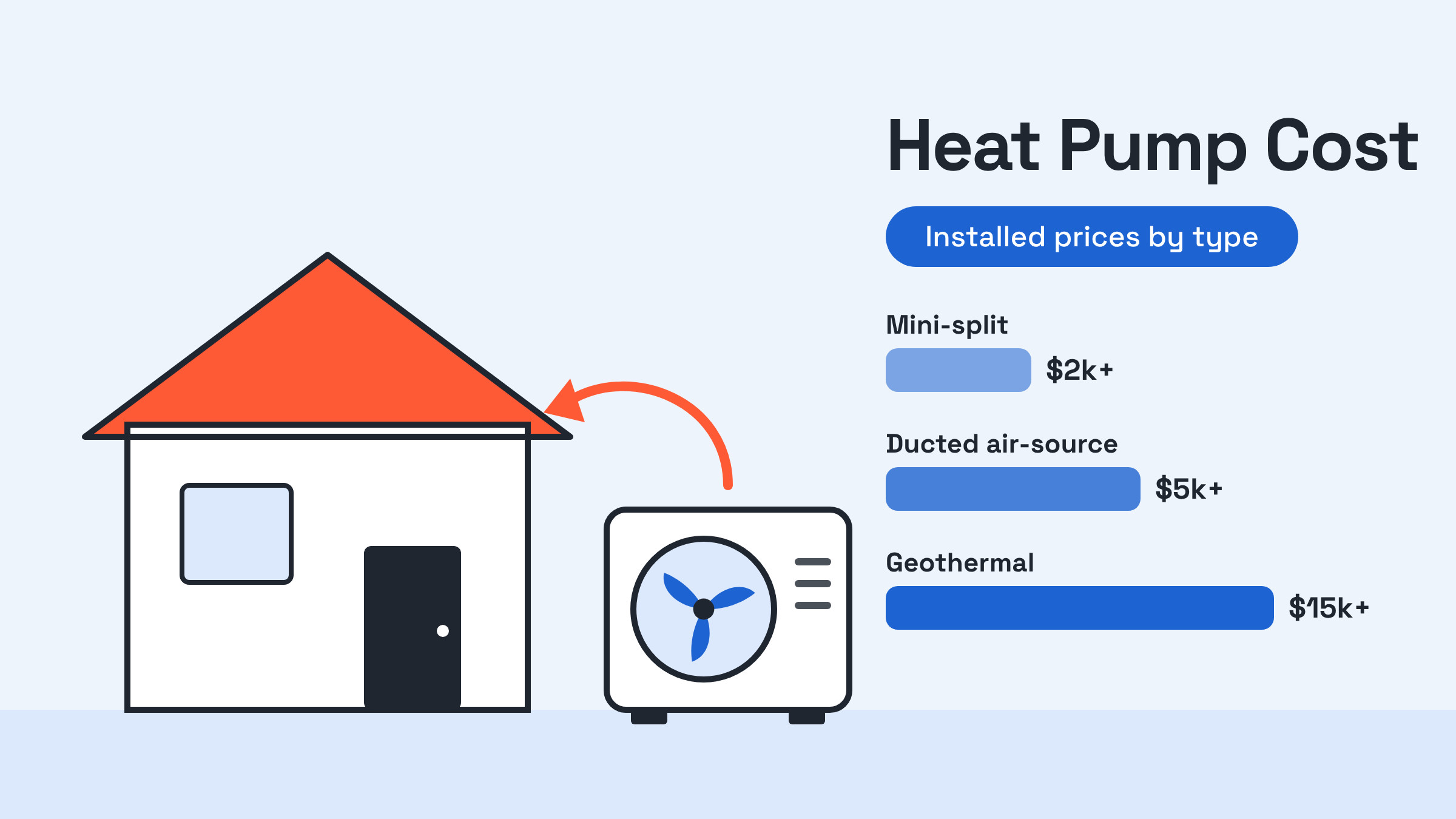
Quick answer: the typical heat pump cost in 2027 is about $10,000 installed for a ducted air-source system, and most homeowners pay between $5,000 and $15,000. A single-zone ductless mini-split starts around $2,000. On the other hand, a cold-climate system can reach $18,000, and geothermal often costs $15,000 to $35,000. Size, type and the electrical work around it set your price.
Quick Numbers
Typical installed prices, including labor, a new line set and removal of the old outdoor unit.
| Heat pump type | Typical price | Common range |
|---|---|---|
| Ducted air-source, standard | $10,000 | $5,000–$15,000 |
| Ducted cold-climate (variable speed) | $13,000 | $9,000–$18,000 |
| Mini-split, single zone | $4,000 | $2,000–$6,000 |
| Mini-split, 3–4 zones | $12,000 | $8,000–$18,000 |
| Dual fuel (heat pump + existing furnace) | $8,000 | $5,000–$12,000 |
| Geothermal (ground-source) | $25,000 | $15,000–$35,000+ |
Ranges: 2026 national installed-price data from consumer cost guides and manufacturer pricing, rounded. Prices are not quotes. Last checked: November 2, 2026.
Calculator
Heat pump cost estimator
Estimated installed price
–
typical range for this job
Typical price
–
middle of the range
System size
–
rounded to the half ton
Show the math
Size = home size × BTU per sq ft for your climate ÷ 12,000 BTU per ton, rounded to the nearest half ton (1.5–5 tons). Price = size × installed cost per ton for the system type (ducted standard $2,000–$3,800, cold-climate $3,200–$5,500, dual fuel $1,800–$3,200, geothermal $6,000–$10,000), with a $5,000 minimum for ducted systems. Mini-splits: $3,000–$6,000 for the first indoor unit and $2,000–$3,500 for each extra one. A panel upgrade adds $1,500–$4,000.
Heat pump cost by type
All heat pumps move heat instead of making it. However, the way they move it, and the work needed to install them, changes the price a lot. Here is what each type costs and who it suits.
Ducted air-source heat pump: $5,000 to $15,000
This is the most common choice. Basically, it looks like a central air conditioner and uses your existing ducts. In fact, if you are already replacing an old AC, a heat pump of the same size usually costs only $500 to $2,000 more. That is because the outdoor unit, line set and indoor coil are almost the same parts.
Cold-climate heat pump: $9,000 to $18,000
Cold-climate models use variable-speed compressors. As a result, they keep heating well below freezing, often down to −5°F or lower. They cost more, but they let you rely less on backup heat strips. For homes in the northern states, this is usually the type to price.
Ductless mini-split: $2,000 to $6,000 per zone
Mini-splits need no ducts. Instead, a small line set runs from the outdoor unit to one or more wall units. A single zone is a cheap way to heat and cool an addition, a garage or a cold bedroom. By contrast, a whole-house system with four or five indoor units can cost as much as a ducted system.
Dual fuel: $5,000 to $12,000
A dual-fuel system adds a heat pump to a furnace you keep. The heat pump handles mild days, and the furnace takes over in deep cold. Because you only buy the outdoor unit and coil, the cost stays lower. It works well when your furnace is fairly new.
Geothermal: $15,000 to $35,000+
Geothermal systems pull heat from the ground through buried loops. As a result, they are the most efficient type and last a long time. However, drilling or trenching makes them the most expensive. Without the old 30% federal credit, the payback is often 15 years or more.
Heat pump cost by size
Heat pumps are sized in tons. Specifically, one ton moves 12,000 BTU of heat per hour. Most homes need between 2 and 5 tons. As a rule, a standard ducted system costs about $2,000 to $3,800 per ton installed, so each extra ton adds a few thousand dollars to the heat pump cost.
| Size | Typical home | Standard ducted | Cold-climate |
|---|---|---|---|
| 2 tons | 1,000–1,400 sq ft | $5,000–$7,600 | $7,000–$11,000 |
| 3 tons | 1,500–2,000 sq ft | $6,000–$11,400 | $9,600–$16,500 |
| 4 tons | 2,000–2,600 sq ft | $8,000–$15,200 | $12,800–$18,000+ |
| 5 tons | 2,600–3,200 sq ft | $10,000–$19,000 | $16,000–$22,000+ |
Keep in mind that square footage is only a starting point. Insulation, windows, ceiling height and your climate matter just as much. Therefore, ask for a Manual J load calculation. A correctly sized heat pump is often smaller, cheaper and more comfortable than a rule-of-thumb guess.
What else adds to the heat pump cost
Of course, the outdoor unit is only one line on the quote. In fact, the extras below explain most of the gap between a $6,000 bid and a $16,000 bid for the same house.
| Item | Typical cost | When you need it |
|---|---|---|
| Electrical panel upgrade | $1,500–$4,000 | Older 60–100 amp panels with no free space |
| New 240-volt circuit | $300–$1,500 | No existing AC circuit nearby |
| Duct repairs or new ducts | $1,000–$5,000+ | Leaky, small or missing ducts |
| Backup heat strips | $300–$800 | Most all-electric systems in cold areas |
| Pad, wall bracket or stand | $150–$500 | Snowy areas need the unit raised |
| Smart thermostat | $150–$400 | Needed for variable-speed and dual fuel |
| Permit and inspection | $100–$500 | Required in most cities |
For example, a panel upgrade alone can add 20% to the bill. So check your panel before you collect quotes. If it is 100 amps and full, mention it to every contractor so the bids compare the same work.
How climate and region change the price
Where you live affects the heat pump cost in two ways. First, it sets the size and type you need. Second, it sets local labor rates.
- South and Southwest: a standard single-stage or two-stage system is usually enough. Because cooling dominates, many owners pay at the low end of the range.
- Mid-Atlantic and Midwest: two-stage or variable-speed units make sense. Prices tend to sit near the national average.
- Northeast, Upper Midwest and mountain states: a cold-climate model, or dual fuel, is the safe choice. Together with higher labor rates, that often adds 20% to 40%.
Likewise, big metro areas cost more than small towns. For example, the same 3-ton job can differ by $2,000 or more between a large coastal city and a rural county.
Brand tier
Premium brands often cost $1,000 to $3,000 more than value brands for a similar system. However, the installer matters more than the logo. A well-installed value unit will beat a poorly installed premium one. So compare the contractor’s reviews, the labor warranty and the model’s ratings before the brand.
Efficiency ratings and what they cost
Heat pumps carry two main ratings. SEER2 measures cooling efficiency, while HSPF2 measures heating efficiency over a season. Higher numbers mean lower bills, but they also raise the heat pump cost up front.
- Entry level (about 14.3–15 SEER2, 7.5 HSPF2): the lowest price, single-stage, fine for mild climates.
- Mid range (16–18 SEER2, 8–8.5 HSPF2): two-stage or variable speed, usually $1,000 to $2,500 more.
- High end (19+ SEER2, 9+ HSPF2): variable speed, quietest and best in cold weather, often $3,000 to $5,000 more.
In practice, the heating rating matters most where winters are long. Meanwhile, in the South, cooling efficiency drives the savings. The Department of Energy’s heat pump guide explains the ratings in more detail.
The math: will a heat pump lower your bills?
A heat pump only saves money if its heat costs less than your current fuel. To compare fairly, we convert everything to the cost of one million BTU of heat. Here is the math for a home that needs 40 million BTU a season at this winter’s national average prices from the EIA Winter Fuels Outlook.
Heat pump: 40 million BTU × 293 kWh ÷ COP 2.8 × $0.182 = $762 a season
Gas furnace (95%): 421 therms × $1.30 = $547
Propane (95%): $1,160 · Oil (85%): $1,787 · Electric baseboard: $2,134
In other words, a heat pump beats propane, oil and electric resistance heat by a wide margin. Against cheap natural gas, however, it needs a seasonal COP of about 3.9 to break even at these prices. Most air-source systems average less than that over a full winter. As a result, the case is strongest when you are leaving an expensive fuel behind.
| Replacing… | Yearly savings | Payback on a $10,000 heat pump |
|---|---|---|
| Electric baseboard or furnace | about $1,370 | about 7 years (faster if you need AC anyway) |
| Heating oil | about $1,025 | about 10 years |
| Propane | about $400 | 15+ years, unless AC is also due |
| Natural gas | costs about $215 more | does not pay back on heating alone |
Still, there is a key detail. A heat pump also replaces your air conditioner. So if your AC is due, compare the heat pump cost with the price of a new AC, not with zero. That extra is often just $1,000 to $2,000, and then the payback against propane or oil drops to a few years.
What it costs to run in summer
A heat pump cools exactly like a central air conditioner. In fact, a 16 SEER2 heat pump uses the same power as a 16 SEER2 AC. So if you replace an old 10 SEER air conditioner, your summer bill can drop by a third. For instance, a 3-ton system that runs 1,200 hours a season uses about 2,700 kWh at 16 SEER2. At 18.2¢/kWh, that is roughly $490, compared with about $790 for an old 10 SEER unit.
Heat pump cost vs. a new furnace and AC
Many owners face this choice when both systems are old at the same time. A new gas furnace plus a central AC typically costs $10,000 to $14,000 installed. Meanwhile, a ducted heat pump with backup heat strips lands in a similar range. So the decision rests on running costs and climate, not on the purchase price.
If you heat with gas and live in a cold state, a dual-fuel setup is often the best of both. If you heat with anything else, a heat pump is hard to beat. For the furnace side of the comparison, see our guide to what a new furnace costs in 2027.
Installation: what to expect
A straightforward swap of an old AC or heat pump takes one or two days. First, the crew recovers the old refrigerant and removes the outdoor unit. Next, they set the new unit, replace or flush the line set and install a matching indoor coil. Then they pressure-test the lines, pull a vacuum, charge the system and set up the thermostat.
By contrast, a mini-split with several zones can take two to four days. Likewise, any panel upgrade needs a utility disconnect, which you may have to schedule in advance. Finally, the inspector visits after the job in most cities. Ask who books that visit, because it affects your warranty.
Lifetime cost: maintenance and repairs
The purchase price is only part of the real heat pump cost. Over 15 years, you will also pay for upkeep. Fortunately, the numbers are modest if you plan for them.
| Item | Typical cost | How often |
|---|---|---|
| Professional tune-up | $100–$250 | Once a year |
| Filters | $20–$100 a year | Every 1–3 months |
| Capacitor or contactor | $150–$400 | Once or twice in a lifetime |
| Fan motor | $400–$900 | Sometimes after year 8 |
| Compressor (out of warranty) | $2,000–$4,500 | Rare; often a reason to replace |
For that reason, register the unit for the 10-year parts warranty, and keep your service receipts. Many manufacturers ask for them before they approve a claim.
Rebates and incentives in 2027
The federal 25C tax credit, which paid 30% up to $2,000, ended for heat pumps installed after December 31, 2025. Therefore, the full heat pump cost now falls on you unless a state or utility program helps.
- Utility rebates: many electric utilities still pay several hundred to a few thousand dollars for qualifying models. Check before you sign, because some require a pre-approved contractor.
- State HEAR rebates: income-qualified households can get up to $8,000 toward a heat pump, but only in states that have launched their programs.
- Manufacturer promotions: spring and fall often bring $500 to $1,500 off higher-efficiency lines.
Rules change often, so confirm each offer in writing. Last checked: November 2, 2026.
How to lower your heat pump cost
- Get three quotes with the same size, model tier and scope. Bids for the same home often differ by 30% or more.
- Seal and insulate first. A tighter home can drop a size, which saves $2,000 or more.
- Keep good ducts. Reusing sound ductwork avoids the biggest add-on cost.
- Look at a 120-volt or load-managed setup if your panel is full. It can avoid a panel upgrade.
- Time it well. Spring and early fall are slower, and prices are often lower.
Also, ask about the warranty. Many brands give 10 years on parts only after online registration, while labor coverage comes from the installer. Our heat pump guides cover sizing, cold weather and running costs in more depth.
Is your heat pump quote fair? Three quick checks
Once the bids arrive, a few simple checks will tell you whether a price makes sense. Use them before you negotiate.
- Divide by tons. For a standard ducted system, $2,000 to $3,800 per ton is normal. Above $5,000 per ton, the quote should include a cold-climate unit, ducts or electrical work. If it does not, ask why.
- Match the model numbers. Look up the outdoor unit and the indoor coil together in the AHRI directory. A certified match is what earns the rated SEER2 and HSPF2, and it is often required for rebates.
- Read what is left out. Permits, the line set, the pad, the thermostat and haul-away should be on the quote. If one bid lists them and another does not, the cheaper bid may not be cheaper.
Finally, compare the labor warranty. One year is the minimum. However, many good installers offer two to ten years, which is worth real money on a system this complex.
Is a heat pump worth the cost?
✓ Worth it if…
- you heat with electricity, oil or propane today
- your central AC is also due for replacement
- you can get a utility or state rebate
✕ Skip it for now if…
- you have cheap natural gas and a furnace under 10 years old
- your panel needs a costly upgrade and no rebate helps
- you only have one quote
FAQ
How much does a heat pump cost for a 2,000 sq ft house?
Most 2,000 sq ft homes need 3 to 4 tons. A standard ducted system costs about $6,000 to $15,000, while a cold-climate model runs $9,600 to $18,000.
Is a heat pump cheaper than a furnace and AC?
The purchase price is similar. Running costs decide it: a heat pump wins against oil, propane and electric heat, but usually not against cheap gas.
How long does a heat pump last?
Air-source heat pumps last about 12 to 15 years. Geothermal indoor units last 20+ years, and the ground loop can last 50.
Is there still a federal tax credit for heat pumps?
No. The 25C credit ended for systems installed after December 31, 2025. State and utility rebates may still apply. Last checked: November 2, 2026.
Do I need to replace my ducts?
Usually not. Most heat pumps reuse existing ducts if they are sealed and sized for the airflow.
How we calculated this
Installed prices combine 2026 national data from consumer cost guides (Angi, Fixr, ConsumerAffairs, PickHVAC) with manufacturer pricing, rounded to the nearest $100. Running costs use EIA winter 2026–27 national average prices: electricity 18.2¢/kWh, gas $1.30/therm, propane $2.52/gal and heating oil $5.26/gal. We assume a seasonal COP of 2.8 for an air-source heat pump. You can check the air conditioning side in our AC guides. Our methodology.
Sources: EIA Winter Fuels Outlook (Oct. 2026); U.S. Department of Energy, Energy Saver. Last checked: November 2, 2026.